Q&A With Raffael Bader
In the summer of 2024, Leipzig-based artist Raffael Bader joined Colstoun Arts for a residency in East Lothian, working within the East Lothian landscape which is shaped by slow rhythms, weather, and history.
We built a friendship which for me is one of the most important parts of the residency and I have felt emotionally invested in everything Raffael has done subsequently. Since then, he has exhibited across the UK, Europe and the Far East. Raffael's upcoming exhibition Soft Embers of Becoming begins 28th February, this new solo is presented by GALLERY HAYASHI + ART BRIDGE in Tokyo, in collaboration with Enari Gallery, Amsterdam.
In this exhibition Raffael brings together a body of paintings attentive to subtle movement and quiet transformation, the exhibition reflects Bader’s ongoing interest in states of becoming that unfold beneath the visible surface. Ahead of the exhibition, we spoke with the artist about painting as a site of listening, the role of duration in his work, and how past experiences, including visiting Colstoun continue to resonate within the studio. Additionally, we have included below the mini documentary “Traverse Heights Right to the Edges” about Raffael’s exhibition in Taiwan last year which gives a great insight into his thought process and practice.
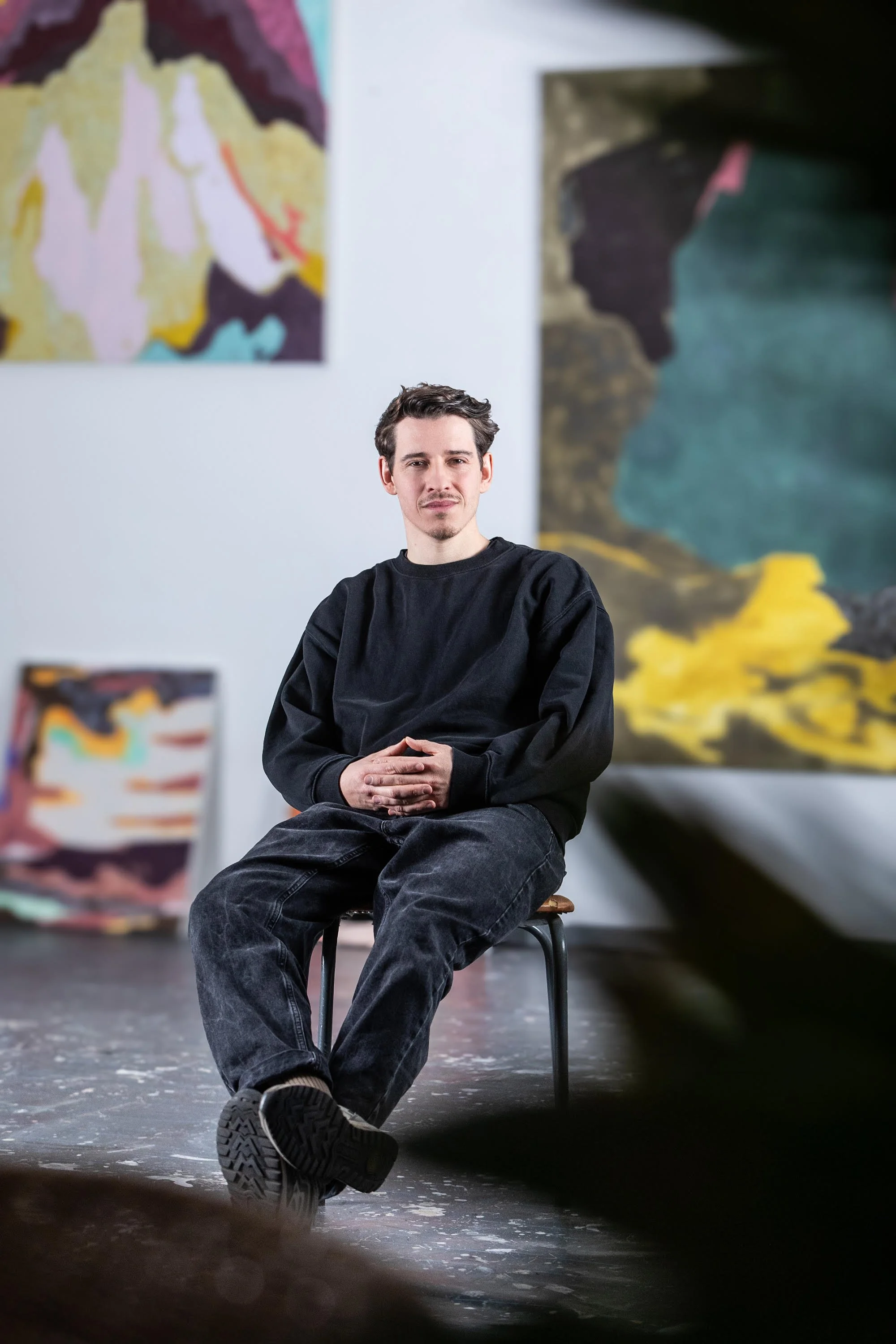
Raffael Bader in his Leipzig Studio photographed by Nils Günther-Alavanja - image courtesy of the artist
MSP: Soft Embers of Becoming suggests a condition of quiet heat — a state that is neither dormant nor fully ignited. The title feels less like an announcement than an invitation to attune oneself to something already underway. What informed the title of this exhibition and for viewers encountering the exhibition, what kind of attentiveness or sensibility do you hope they bring with them?
RB: I think that everything is in motion; nothing really stays still. In every physical element of our world lies a potential for transformation — or rather, multiple potentials for different transformations. Take wood, for example: it grows, develops leaves, spreads roots, and at the same time harbours fire slumbering within it. That is pure life. We can only ever perceive a brief glimpse of a moment within that transformation. Soft Embers are those blurred potentials — the different ways life could unfold. And I am speaking of life as an all-encompassing energy that flows through everything. I hope that viewers will catch some of these glimpses and perhaps even recognise them in their own lives and surroundings, as we are all soft embers ourselves.
MSP: This exhibition marks your second solo presentation in Japan, following Walk in Sizzling Air at the Contemporary Art Foundation, Tokyo in 2023, and comes after your two-person exhibition Movement in the same year. For a European artist, this sustained dialogue with Japan feels significant. Do you sense a particular affinity between your way of thinking through painting and Japanese visual or philosophical traditions? or is there some other significant resonance between your work and Japan?
RB: Japan has always been one of those places of longing in my life. What fascinates me in particular is the way traditional Japanese woodblock prints, especially Ukiyo-e, developed a timeless approach to depicting nature — animated nature — and the relationship between humans and their environment. Although clearly born from a specific cultural soil, I believe this tradition succeeded in becoming a visual language that does not rely solely on cultural background to be understood. I feel that parts of my own work may be roaming similar paths: exploring the possibility of a visual language based on the interrelationship between humans and nature — or perhaps on the idea of humans as nature.
MSP: Across your paintings there is a strong sense of providing exactly what is required and no more: forms appear carefully calibrated, offering just enough definition to guide the eye while remaining open and porous. Given your interest in matter as something animated and responsive rather than fixed, how do you decide when a form has reached its necessary degree of presence — when it should speak, and when it should remain quiet?
RB: I hope for forms that retain their potential for transformation. For me, painting does not depict a fixed moment, but rather suggests what might be possible. This is a delicate balancing act that relies heavily on intuition. And I believe intuition is precisely the place where our connection to the organic world is strongest. Some colours and forms are louder than others and draw attention; some recede and hide behind others. Finding the right relationship between them is essential. Since I think of painting as an abstract visual language — though, in a way, every language is abstract — I look for forms that hint at something specific while remaining open enough for viewers to form their own associations. Here again, I rely on my intuition and my own sense of what unfolds on the canvas.
MSP: It has now been over a year since your residency at Colstoun Arts, where you spent a sustained period working within a rural and historically layered environment. Looking back, are there aspects of that time — spatial, material, or perceptual — that have quietly embedded themselves in your ongoing practice, perhaps in ways that only became visible later?
RB: My time in Scotland at Colstoun Arts during the summer of 2024 was significant in many ways. For one thing, the weather was highly perceptible, constantly drawing attention to itself — as if spring, summer, autumn, and winter could all unfold within a single day. Located in the Lowlands, Colstoun is framed by the coastline and by the Lammermuir Hills. Dense forests and wildlife surround the area, reaching even onto the premises of the residency. The garden itself reflects a larger natural landscape, somewhat reminiscent of a traditional Japanese garden, though rooted in a completely different cultural tradition. In this setting — and in being, in a sense, removed from the world and far from my daily life — I was able to focus on presence and reconnect with trees, plants, rocks, rivers, and wildlife. This experience has become one of those inner places I return to from time to time, mentally wandering through a valley that continues to find its way into my artistic process.
By talking with Raffael I have understood that his practice is less about the act of "making" and more about the art of "listening." Bader has cultivated a language where the canvas acts as a living membrane. Soft Embers of Becoming stands as a testament to this sensitivity, offering a space where the viewer is not merely a spectator, but a participant in a shared state of potential. As the works prepare to migrate to the energy of Tokyo, they carry with them a profound reminder: that beneath the static surface of our world, there is a persistent, glowing vitality—a slow ignition that connects the human spirit to the very matter of the earth. more information about works available can be received through the gallery and you can contact them via their website
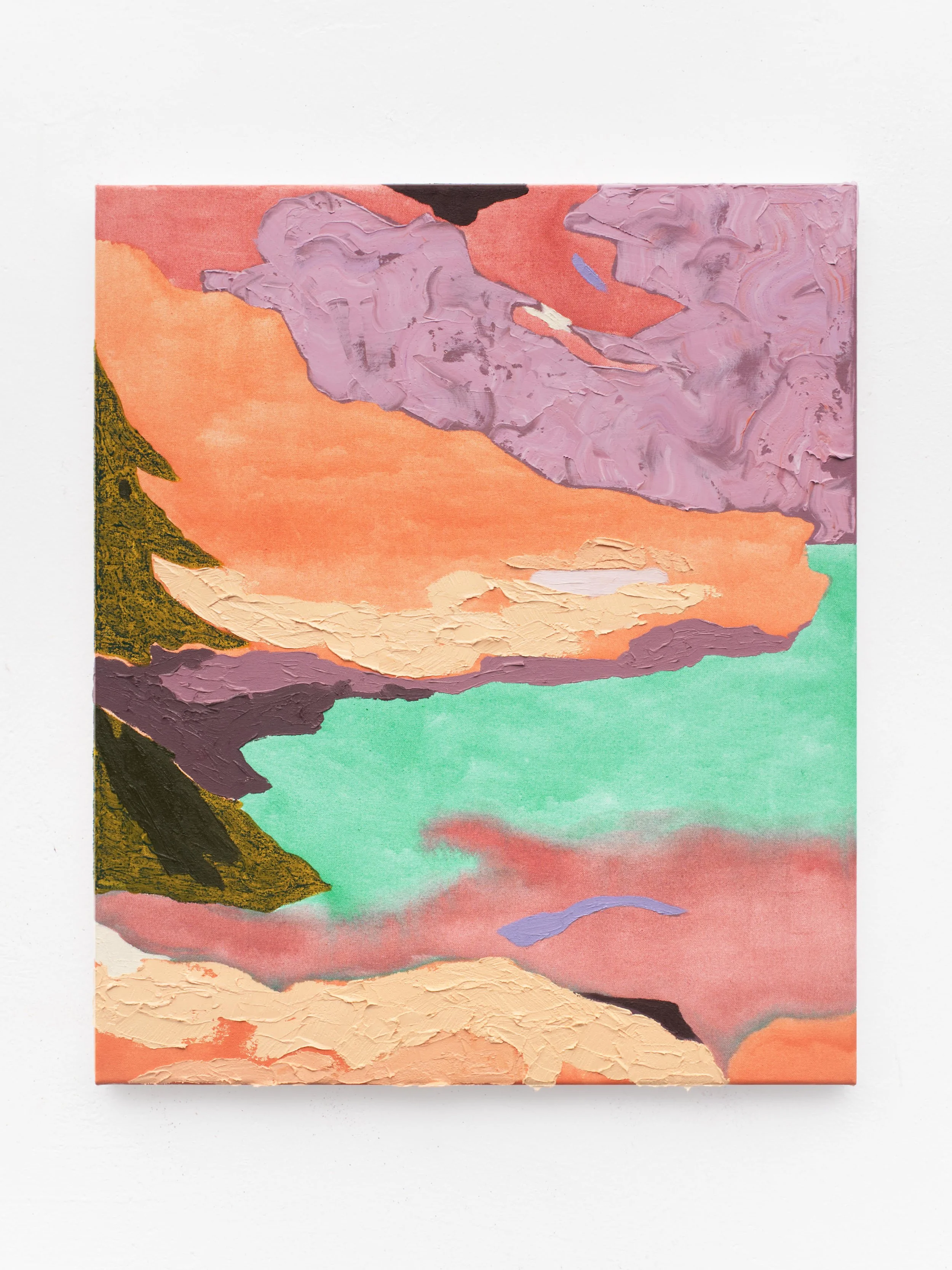
Raffael Bader painting: “Sound of Late Summer Mornings”, oil on canvas, 65 x 55 cm, 2025
GALLERY HAYASHI + ART BRIDGE: is a contemporary art gallery located in the Ginza district of Tokyo, Japan, originally established as Gallery Hayashi in 2008 and later expanded to include the Art Bridge initiative, which focuses on presenting young contemporary artists alongside works that reflect the development of Japanese art since the modern era. The gallery’s exhibitions have featured a range of artists working in mainly painting and abstract expression; recent solo shows include Midori Arai with Refle; fraction and Jungwon Phee with Ma, both presented in Tokyo at the gallery’s space. Group exhibitions such as Women in Abstraction have showcased artists including Midori Arai, Misako Kon, Reina Mikame, and in later editions Mio Ito, Momoka Ota, and Yukari Suematsu. Other artists associated with the gallery’s programmes include Mio Ito, Yuiha Yamaguchi, Genki Yamashita, and Rangga Aputra. The gallery is open to the public with free admission and holds exhibitions that range across solo and group presentations, reflecting both Japanese and broader Asian contemporary artistic practices.
Enari Gallery: is a contemporary art gallery located at Utrechtsestraat 44 in the centre of Amsterdam, The Netherlands. It was founded by Paul van Gemen and Christina Voulgari and opened its doors in mid-November 2022 with the aim of presenting exhibitions that bring together both emerging and established international artists, fostering exchange between the Dutch cultural scene and the wider global art world. The gallery participates in international art fairs such as UNTITLED ART 2025 and CAN Art Fair 2025, where it presents works by artists including Johanna Bath, Dimitris Tampakis, Emre Özakat, Douglas Cantor, Ioanna Limniou, Tom Solty, and Lindsay Merrill. Enari Gallery also hosts group and solo exhibitions in its Amsterdam space; past shows have featured exhibitions such as Moons with artists Johanna Bath, Amy Beager, Maya Fuji, Ariane Heloise Hughes, Minyoung Kim, and *Ioanna Limniou. The gallery’s programme reflects a range of contemporary practices and media, and it regularly appears in the Amsterdam contemporary art calendar.
Raffael Bader CV:
Education:
2012 - 19 Painting at the Academy of Fine Arts (HGB), Leipzig, Germany. Under supervision of Prof. Ingo Meller.
2019 Diploma at the Academy of Fine Arts (HGB), Leipzig, Germany.
Grants and Residencies:
2025: Acquisition by the Cultural Foundation of the Free State of Saxony as part of the annual art purchases, DE
2024: Residency at Colstoun Arts, Scotland, UK
2021: Work scholarship, Stiftung Kunstfonds, Bonn, DE
2020: DENKZEIT, Kulturstiftung des Freistaates Sachsen, DE
Selected Solo Exhibitions:
2025: Feral Within, Fred Levine, Bruton, UK | Travers Heights Right to the Edges, Yiri Arts, Taipei, TW
2024: Luminous Floating, Enari Gallery, Amsterdam, NL | Enigmatic Stream, Galerie Philipp Anders, Leipzig, DE | T-10 Project, Alzueta Gallery, Barcelona, ES
2023: Walk in Sizzling Air, Contemporary Art Foundation Tokyo, JP
2022: Roam Inaccessible Paths, BWG Gallery, London, UK
2021: Stormy Skies, Rocket Science, Brooklyn, NY, USA
2020: von hier aus sichtbar, S1, Leipzig, DE
2019: umfasste linien, Acht-Zwei, Leipzig, DE | geworden, Galerie Potemka, Leipzig, DE
Notable Collections:
Yusaku Maezawa, CAF Tokyo, JP Staatliche Kunstsammlung Dresden, DE Private Collections worldwide
Publications:
2024: Raffael Bader: Walk in Sizzling Air, 22 x 16,5 cm, edition: 150
2022: Raffael Bader: ’22, 22,5 x 17 cm, edition: 150
2021: Raffael Bader: On Two Islands, 22 x 16,5 cm, edition: 100
2020: Raffael Bader: Traveling Museum Attendant, 19 x 12,5 cm, edition: 100
Exhibition Publications:
2021: Im Flutlicht, Historische Fotografie und zeitgenössische Kunst, Ausstellungskatalog. Published by BSG Chemie Leipzig e.V.
2020: Winter Marathon, Becoming Habits Chapter 1,2,3, St. Moritz Switzerland. Published by Studi0 GmbH
