 Image 1 of 1
Triquetra (Colstoun Water) - Jen Hitchings
Jen Hitchings
Triquetra (Colstoun Water)
Oil & Acrylic on Canvas
91 x 121cm
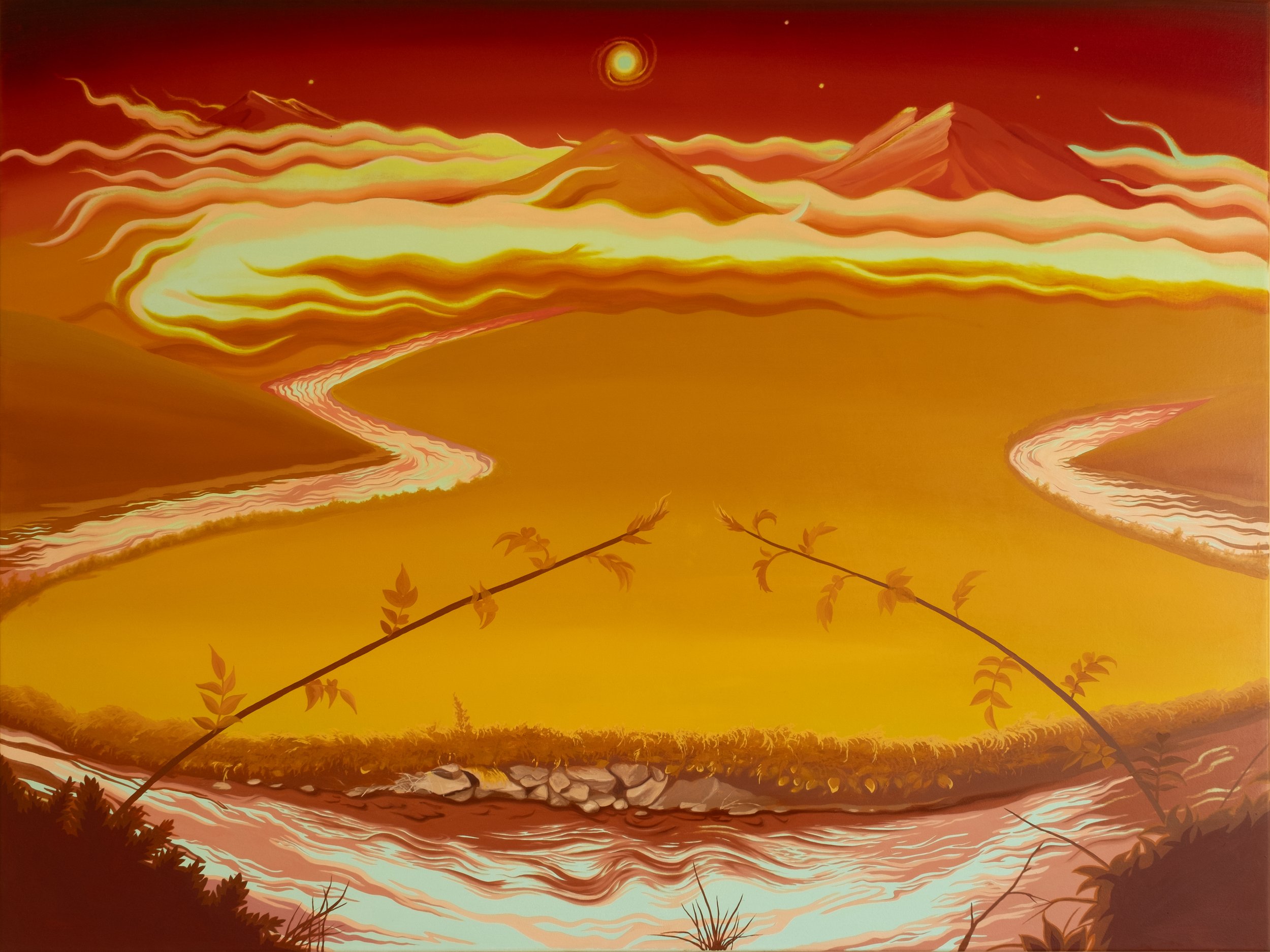
Jen Hitchings’ Triquetra is a luminous, transcendental exploration of the natural world, rendered with a dreamlike precision that sits at the intersection of mythical exploration and artifice. Executed by the American artist (b. 1988), the work exemplifies her ability to transmute the traditional landscape into a heightened, psychological space—one defined by rhythmic linework and a vibrant, unearthly palette.
At first encounter, the incendiary sky dominates: a deep, saturated ochre and crimson expanse that feels both ancient and apocalyptic. A haloed celestial body hangs at the zenith, casting a spectral glow over a series of undulating, ribbon-like clouds that surge across the upper register. These formations possess a serpentine energy, their cream and gold edges glowing with a neon intensity that suggests a world caught in a permanent, glowing twilight. The atmosphere here is not merely a backdrop; it is a pressurized, vibrant entity that hums with a quiet, cosmic electricity.
Below, the landscape unfolds in a series of graphic, fluid tiers. Hitchings’ brushwork is characterized by a remarkable smoothness, where the terrestrial elements—rivers, mountains, and banks—are treated with a stylized, almost topographical clarity. The water, rendered in pale pinks and celadon greens, snakes through the golden terrain with a rhythmic grace that recalls the woodblock prints of the Ukiyo-e masters, yet remains firmly rooted in a contemporary, digital-adjacent aesthetic.
The compositional tension is anchored by the foreground: two delicate, arching branches that frame the central vista. This subtle architectural framing creates a sense of voyeurism, as if the viewer is peering through a threshold into a forbidden or sacred valley. The contrast between the soft, diffused light of the distant mountains and the sharp, graphic silhouettes of the foreground foliage creates a compelling depth—a "stacked" perspective that emphasizes the painting’s curated, constructed nature.
In the context of Hitchings’ evolving practice, this work represents a masterful balance of expressive color and structural harmony. It avoids the pitfalls of sentimentalism through its sheer technical rigor and its embrace of the "uncanny" landscape. For the observer, the piece offers an invitation to lose oneself in a world that is at once familiar in its geography and alien in its execution—a testament to Hitchings' status as a vital voice in contemporary American landscape painting.
All works on this page are offered Price on Application (POA). In keeping with established gallery practice, prices are provided discreetly upon request to ensure a considered and informed dialogue with collectors. Should you proceed to the checkout stage, the works will appear as £0 — this is simply a technical placeholder within the website system and does not reflect the value of the artwork. Once an enquiry is submitted, we will respond promptly with full details, including pricing, availability, and any additional information required.
This approach allows us to maintain the integrity of the sales process while offering collectors a direct and personalised exchange.
Jen Hitchings
Triquetra (Colstoun Water)
Oil & Acrylic on Canvas
91 x 121cm
Jen Hitchings’ Triquetra is a luminous, transcendental exploration of the natural world, rendered with a dreamlike precision that sits at the intersection of mythical exploration and artifice. Executed by the American artist (b. 1988), the work exemplifies her ability to transmute the traditional landscape into a heightened, psychological space—one defined by rhythmic linework and a vibrant, unearthly palette.
At first encounter, the incendiary sky dominates: a deep, saturated ochre and crimson expanse that feels both ancient and apocalyptic. A haloed celestial body hangs at the zenith, casting a spectral glow over a series of undulating, ribbon-like clouds that surge across the upper register. These formations possess a serpentine energy, their cream and gold edges glowing with a neon intensity that suggests a world caught in a permanent, glowing twilight. The atmosphere here is not merely a backdrop; it is a pressurized, vibrant entity that hums with a quiet, cosmic electricity.
Below, the landscape unfolds in a series of graphic, fluid tiers. Hitchings’ brushwork is characterized by a remarkable smoothness, where the terrestrial elements—rivers, mountains, and banks—are treated with a stylized, almost topographical clarity. The water, rendered in pale pinks and celadon greens, snakes through the golden terrain with a rhythmic grace that recalls the woodblock prints of the Ukiyo-e masters, yet remains firmly rooted in a contemporary, digital-adjacent aesthetic.
The compositional tension is anchored by the foreground: two delicate, arching branches that frame the central vista. This subtle architectural framing creates a sense of voyeurism, as if the viewer is peering through a threshold into a forbidden or sacred valley. The contrast between the soft, diffused light of the distant mountains and the sharp, graphic silhouettes of the foreground foliage creates a compelling depth—a "stacked" perspective that emphasizes the painting’s curated, constructed nature.
In the context of Hitchings’ evolving practice, this work represents a masterful balance of expressive color and structural harmony. It avoids the pitfalls of sentimentalism through its sheer technical rigor and its embrace of the "uncanny" landscape. For the observer, the piece offers an invitation to lose oneself in a world that is at once familiar in its geography and alien in its execution—a testament to Hitchings' status as a vital voice in contemporary American landscape painting.
All works on this page are offered Price on Application (POA). In keeping with established gallery practice, prices are provided discreetly upon request to ensure a considered and informed dialogue with collectors. Should you proceed to the checkout stage, the works will appear as £0 — this is simply a technical placeholder within the website system and does not reflect the value of the artwork. Once an enquiry is submitted, we will respond promptly with full details, including pricing, availability, and any additional information required.
This approach allows us to maintain the integrity of the sales process while offering collectors a direct and personalised exchange.