I first encountered Alina Zamanova's work by chance, stepping out of the Groucho Club in Soho in September 2022, newly returned from the frontlines of Kharkiv Oblast. Ukraine, and the war's long shadow, had come to occupy most of my thinking; across the street, at The Smallest Gallery in Soho, Alina's exhibition Our Children Are Fighting Too was on view. The coincidence felt pointed.
What began there has continued since. In 2023, following a series of conversations, Colstoun Arts supported Alina in the realisation of Child (2023), her first sculptural work (pictured below). This year she opens Fallout of Silence with General Assembly in London — an exhibition made, like so much of her recent practice, under the pressure of a war now entering its fifth year. In the weeks leading up to the opening, I spoke with her about her work, her process, and how life in Ukraine has shifted across four years of full-scale invasion.
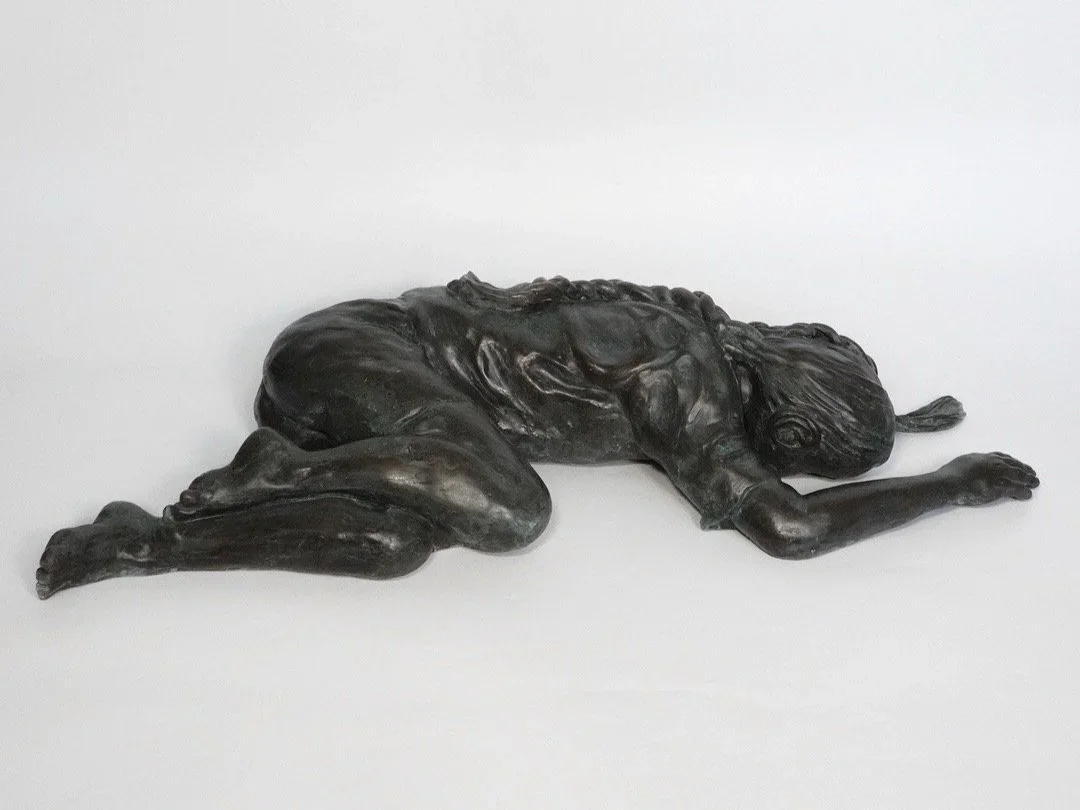
“Child” , 2023
Polyester resin with bronze powder
91 x 38 x 15 cm
Limited Edition of 5+ 2AP
MSP: The exhibition text describes the "moment after an attack" — the disorienting quiet rather than the violence itself. Can you talk about why you choose to paint the aftermath rather than the event, and what you hope viewers access through that silence?
AZ: What I'm thinking is that sometimes it's more difficult to live through the aftermath with trauma and grief, emotions flooding you days and hours after something quite traumatic happened to you. Usually when you're experiencing the trauma, shocking moments in your life, you have this response based on adrenaline, and you act accordingly in the moment as your body and mind reacts in a natural way when the danger is in front of you. But what is more difficult is to actually come out later from this trauma, try to go back to your old self, or try to pick up where you left before this happened. That is why to me it feels that this deafening silence that can occur to you in those heavy moments afterwards, it's something even more scarier than the actual moment.
MSP: You collect fallen branches and soil from personally significant sites in Ukraine and call them "grounded material." How does working with these physical fragments of the landscape change the way you approach a painting, compared to working purely from photographs or memory?
AZ: Perhaps it feels a little bit more sacred and intimate process, like having deeper relationship with the ground and the landscape that surrounds me here in Ukraine. It’s quite fascinating to observe how it works like an anchor, that helps me ground myself in such surreal times and realities that we encounter. For example working with soil that I collect myself in different regions around Ukraine is a special process to me. Blue soil found near Trypillia, is believed to be a healing soil that you rub on your body to recover from pain in joints and to make your skin more soft and young. Sometimes I go near that pool of soil that has a small lake, where the soil slowly run down, and I swim in that lake, it gives this fantastic rejuvenating feeling to your body, this place is special to me in energy. Later I transport the soil back to my studio and I make a figment out of it to use in my “full-scale war self portraits” ongoing series, in which I capture a specific day during the war.
What I noticed while working from memory, these visions can be distorted by time and space, through such prism it can be both intriguing and scary to work from memory because sometimes t’s quite crucial to explain the exact historical moment with correct details. So basically it depends on what is going on in the exact moment of time when I am painting, is it something that I want to show through another more emotional language, or is it an exact historical moment that happened which I want to show through figuration.
MSP: Your trees often appear as shelters — arching trunks forming canopies of protection, yet visibly bent and strained. How consciously do you use the landscape as a metaphor for human endurance, and is there a particular tree or site in Ukraine that anchors that connection for you?
AZ: I think it started out based on intuition, but then later I use it more consciously to translate the experience to other people through natural elements. It’s like finding another language to translate the experience and the thoughts. My grandma garden would be the anchor for me, she used to pay close attention to her roses and peonies, they always gave me the feeling of home. And of course there was a cherry tree that I used to climb when I was a kid and when I come back, I always go back to the garden and sit near trees to ground myself again and to feel this sort of safety that I used to feel when I was a kid.
MSP: You recently completed a residency at Tracey Emin's Victoria House in Margate. What was it like to make work about Ukraine from within a very different landscape, and did that distance change anything in the paintings?
AZ: The paintings turned out different from what I usually paint in Ukraine, as you put yourself in another environment and you look from outside like you’re standing outside of the window and you’re looking into your home through the prism of glass, that is in some parts is shattered, but there is still a lot of light coming through. The experience was definitely life changing, and I am very grateful to Tracey and the whole team at the residency in supporting me in this journey.
MSP: You've spoken before about the mind going into "freeze mode" as a form of self-protection. As an artist, how do you navigate between that protective stillness and the vulnerability required to keep making work about what you're living through?
AZ: For me, “freeze mode” is not something negative - it’s actually what keeps me from burning out, from basically frying my brain, my emotions, everything. It’s like a protective mechanism, but also like an observation deck. I can step back a bit, stay still, watch what’s happening, without being completely overwhelmed by it.
And the important thing is that now I do not stop working completely in that state. I just work differently. I go to the studio, but I don’t try to push myself into something too emotional or too exposed. I stay with what is familiar, what is already in process. For example, this winter in Ukraine, when there were constant attacks on critical infrastructure, everything became very unstable - heating, water, electricity. At some point, it wasn’t even “freeze” anymore, it felt more like survival mode, which was something I had never experienced in that intensity before. But even then, I tried going to the studio. I would be there in layers of clothing,
in the cold, just working on this large painting I had already started. Finishing details, staying inside the process that was already built. At some point I took a decision to go to Poland for a month, so that I can finish my show for London.
So I think for me it’s really about adapting the practice to the state I’m in. Freeze mode doesn’t stop the work - it just changes the way I can access it. And sometimes, that distance, that reduced emotional intensity, is exactly what allows the work to keep existing at all.
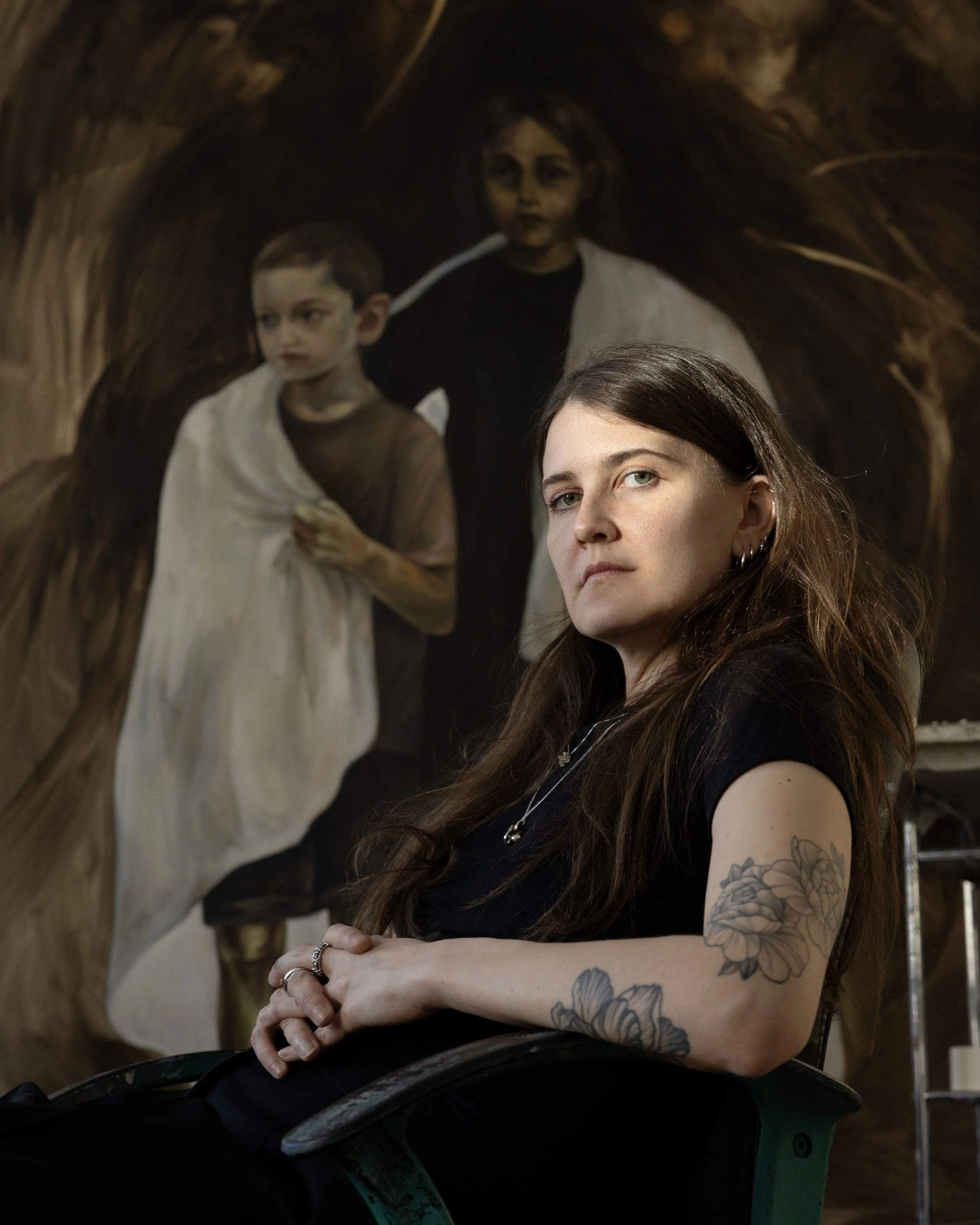
Alina Photographed in her studio by Ukrainian Photographer Kateryna Siienko
What lingers, after the conversation closes, is the sense of a practice built on continuation rather than response. Zamanova does not paint the moment of impact; she paints what arrives afterwards — the deafening quiet, the return to the garden, the slow work of grounding oneself in soil carried back from Trypillia and laid into the surface of a canvas, this echoes with my own experiences of war, it is not the moments of action and loudness that are most impactful, it is the quiet space in between where nothing is happening. Her displacement of her studio practice between Kyiv, Margate and Warsaw, suggests an artist whose language is still expanding under pressure, like so many impacted by war.
Fallout of Silence, Zamanova's solo exhibition at General Assembly, London, runs through 2nd May 2026 and marks one of the most fully realised presentations of her work to date in the UK. Her practice spans painting, works on paper, and sculpture, and is held in private collections across Europe and North America.
Colstoun Arts is a contemporary art organisation based at Colstoun House in East Lothian, Scotland, running an international residency programme and working closely with a small group of emerging and mid-career artists each year. We first supported Alina Zamanova in 2023 through the realisation of Child, her first sculptural work, and continue to follow her practice with real interest.
CV:
Ukraine, b.1993
Lives and works in Kyiv, Ukraine
EDUCATION
2010 - 2011 Kyiv National University of Technologies and Design, BA Graphic Design
2011 - 2012 University of the Arts London, Certificate Higher Education, International Preparations
2012 - 2015 University of the Arts London, BA (Hons) Illustration
SOLO EXHIBITIONS
2025 Embodied Memory Rooted Into a Ruptured Landscape, Mulier Mulier Gallery, Brussels, Belgium 2024 Vibration of Nature, Begijnhofkerk Catholic Church, Mechelen, Belgium 2022 Our Children Are Fighting Too, The Smallest Gallery in Soho, London, UK 2021 Distorted Reality, Chrome Hearts Gallery Space during Art Basel Miami, Miami, USA 2020 Inside Me, Gillian Jason Gallery, London, UK 2019 Ugly game, Art Ramus Gallery, Kyiv, Ukraine 2018 French Ladies, École Française Internationale de Kiev, Kyiv, Ukraine Diverse Beauty, The Old Bank Vault Gallery, London, UK 2017 Art Performance Piece Movement , Mystetskyi Arsenal, Kyiv, Ukraine, 2016 Art Performance Stay Ugly , Mystetskyi Arsenal, Kyiv, Ukraine
GROUP EXHIBITIONS 2025 Tracey Emin Foundation, Residency Final Show, Victoria House, Margate, UK 2024 Crisis of Imagination, зараз Ukraine, Galerie Bleekstraat 7, Mechelen, Belgium 2024 Modern Ukrainian Art Exhibition, Mot x The Collectyv Gallery, Lviv, Ukraine 2024 Fierce Form, Art MegaStar, Los Angeles, USA 2024 Atelier of Dreams, National Ukrainian House, Kyiv, Ukraine 2024 Art For Change, Saatchi Gallery, London, UK 2023 The Loudness of Silence, Cicada Curatorial, curated by Alina Perez and Arel Lisette 2023 Self-Portrait Prize Exhibition, Ruth Borchard, Atkinson Museum, UK 2023 Annual Exhibition, Royal Scottish Academy, Scotland 2023 The Allegory of Power, Modern Art Research Institute, Kyiv, Ukraine 2023 Annual Exhibition, Royal Scottish Academy, Scotland 2022 Bodyland, curated by Lauren Taschen, Max Hetzler Gallery, Berlin, Germany 2022 Aphrodite to Mars, curated by Nina de Maria, Daniel Benjamin Gallery, London, UK 2022 Women Art in times of chaos, Simon De Pury, Online 2022 Dance Macabre, Samuele Visentin, London, UK 2022 Stand With Ukraine, Hales Gallery, London, UK
