Introducing Divya Balivada
Divya Balivada is an Indian artist whose work approaches painting as a site of endurance, release and return. Balivada completed her MA in Painting at the Royal College of Art in September 2025. She was shortlisted for the Inaugural Jaguar x RCA Prize and subsequently featured in the 43rd edition of ‘Small is Beautiful’, a group exhibition at Flowers Gallery. She recently had a solo exhibition at the Royal Society of Arts in London, marking a growing recognition of her practice.
At the heart of Balivada’s work is an engagement with cyclicity and impermanence as fundamental conditions of human experience. Her paintings accumulate gesture, repetition and rhythm. Marks are layered, pressed, covered and reasserted, forming dense fields that seem to hold time within them. Colour is used instinctively with feeling, articulating states that resist language and linear narrative.
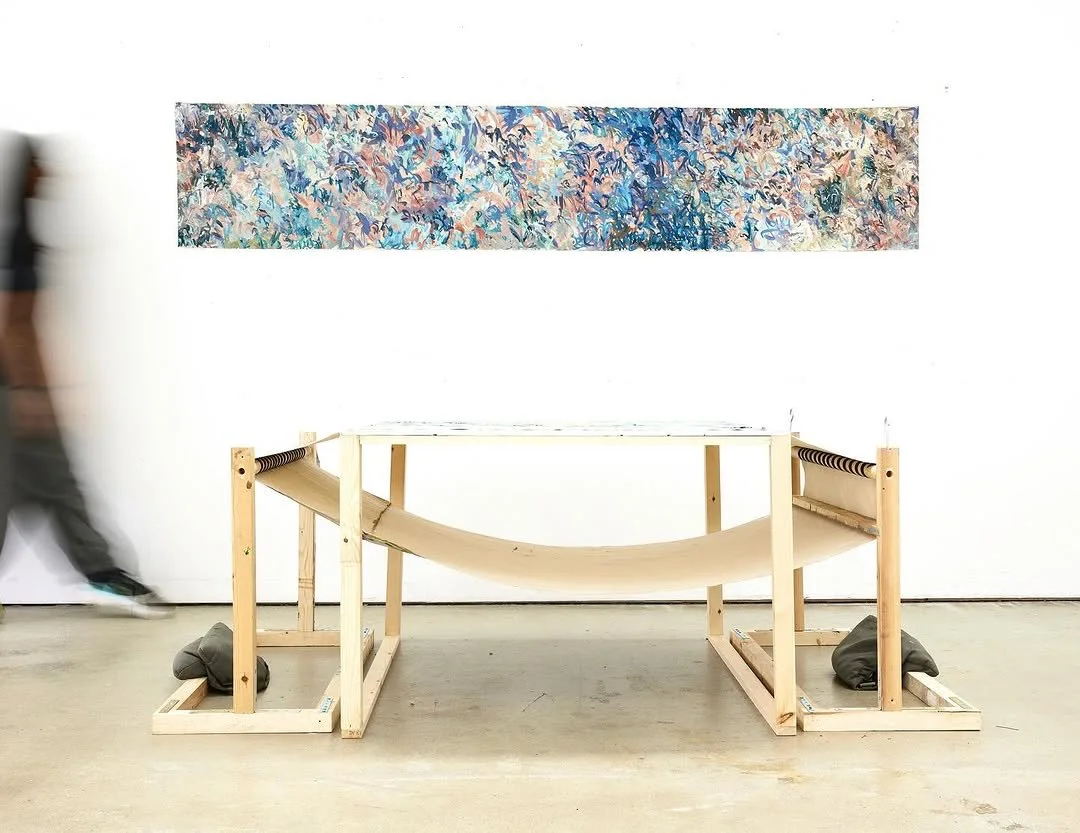
Balivada created a Loop machine to cycle her surfaces again and again, the concept was built out of the idea of “Saṃsāra” the endless cycle of birth, death and rebirth marked by suffering ‘Duhkha”
Balivada’s practice is shaped by personal history and cultural memory. Raised in India, she reflects on how rigid gender norms and the expectation of emotional restraint, often described as “good-girl” conditioning, have shaped female identity and self-expression within Indian society, which was further entrenched by colonisation. Her work dissects the effects of emotional suppression and silence, tracing how trauma and memory persist within the body and resurface through repetition. These concerns are enacted in her paintings, which become sites where suppressed emotions are allowed to surface, circulate, and transform.
Central to this process is Balivada’s self-built loom, and works made on them are the Ananta series. Ananta means infinite or boundless. The loom creates a continuously moving surface, enabling an unbroken stream of mark-making without a fixed beginning or end. The loom facilitates rhythmic, instinctual gestures that bypass conscious control. This cyclical method resists mechanised standardisation and prescriptive forms of making, aligning the act of painting with ritual rather than production. The loom also carries historical and political resonance, referencing India’s handloom traditions and their disruption under colonial industrialisation.
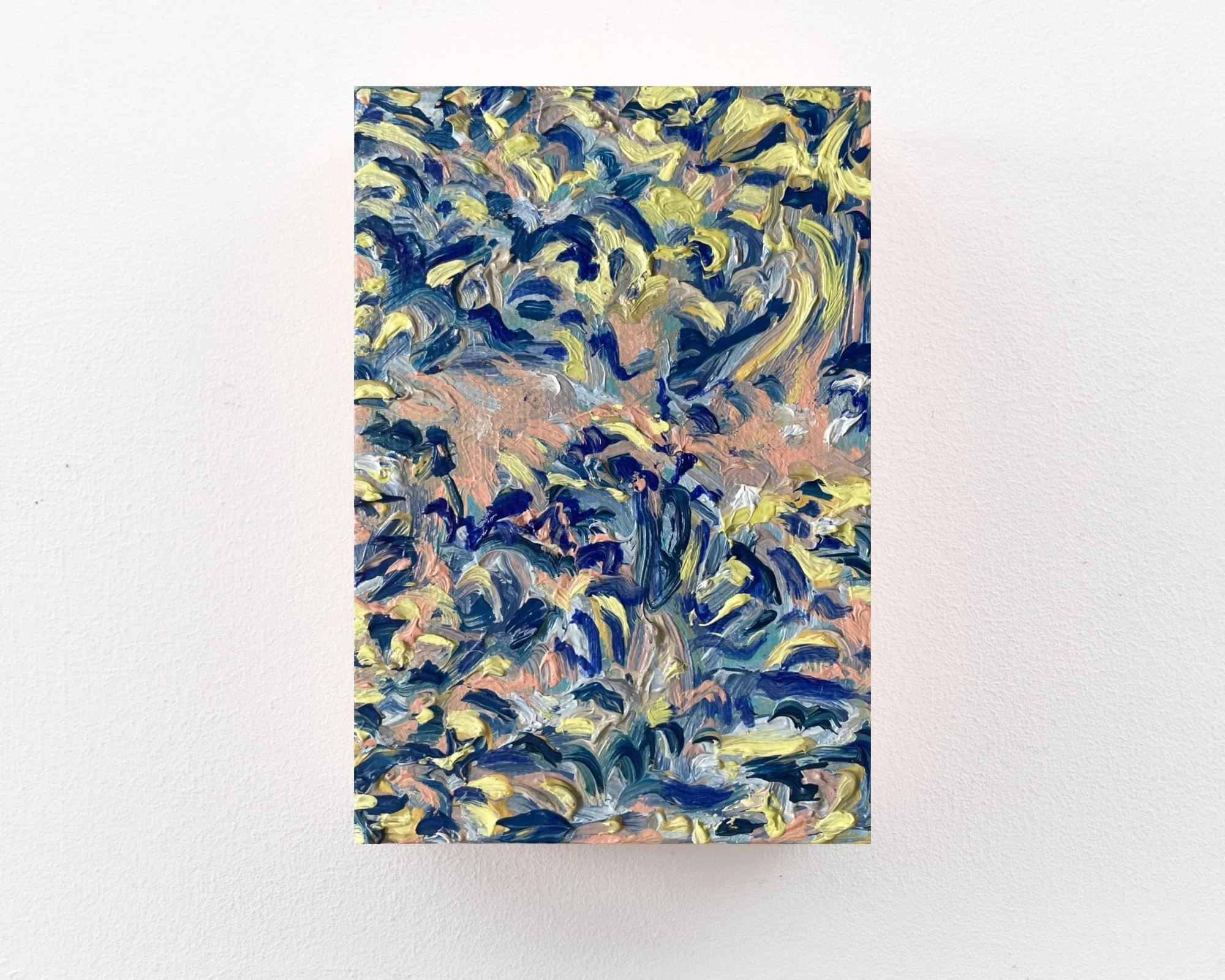
Divya Balivada, Inverse Lot, Oil and acrylic on linen 15.2 x 10.2 cm 6 x 4 in 2025 - presented at Flowers Gallery for their 43rd edition of ‘Small is Beautiful’ a group exhibition
Balivada’s paintings draw from her upbringing in India and the sensorial richness of architecture, textiles and landscapes. “Ornamental” density and chromatic intensity sit alongside abrasion and pressure, producing surfaces that oscillate between excess and restraint. The works invite sustained looking rather than immediate comprehension, offering a space in which viewers may encounter their own rhythms of memory and perception. Balivada describes her practice as a means of claiming autonomy and identity. Through the repetitive, physical act of making, she returns to emotions that are urgent and uncontainable, allowing them to be expressed without mediation. In this sense, her paintings are also processes, records of persistence and resistance.
In introducing Divya Balivada’s work, we encounter a practice that insists on painting as a living, relational act. Although most of the extracted benefits from the colonial past ended up within the walls of Dalhousie Castle, and the number of ornaments from India has significantly diminished over time, we are aware of the estate’s entanglement with Britain’s imperial history, particularly given that the ancestors of its current inhabitants are directly linked to India. Colstoun is therefore not a neutral site, and it is our responsibility to engage in conversation at least to build an open and truthful dialogue where we can let the current generation explore the legacies of colonial power, administration and extraction. Balivada’s practice, rooted in the decolonial, engages with the long afterlife of colonialism through embodied memory, repetition and inherited patterns of behaviour that persist across generations.
In this regard, her self-built rotating loom and cyclical painting process hold particular resonance. Textiles were central to India, and the disruption of indigenous making practices was integral to imperial control. By rejecting mechanisation and standardisation in favour of bodily, rhythmic labour, Balivada offers a quiet counter-history to those systems.
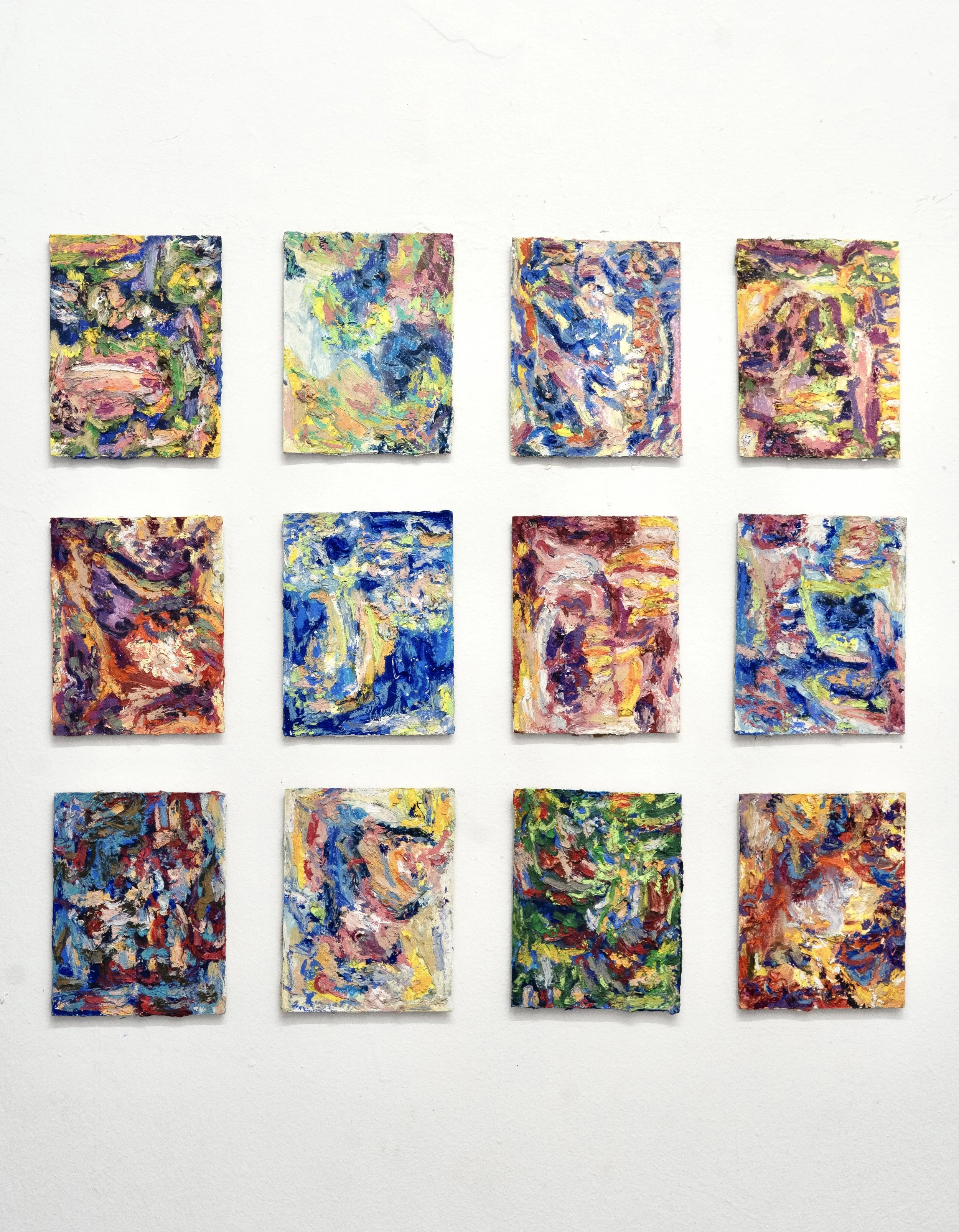
“Days of Staying” - part of “In Transit, In Return” Goa Open Arts 2026
Links: Website - Instagram - RCA profile - Jaguar Awards - Creatix Magazine
